3. Tools for Space Software Development¶
This chapter explains how suppliers of space software can benefit from AdaCore's products. The advantages stem in general from reduced life cycle costs for developing and verifying high-assurance software. More specifically, in connection with space software qualification, several tools can help to show that an application complies with the requirements in ECSS‑E‑ST‑40C and ECSS‑Q‑ST‑80C.
3.1. AdaCore Tools and the Software Life Cycle¶
The software life cycle is often depicted as a V diagram, and the figure below shows how AdaCore's major products fit into the various stages. Although the stages are rarely performed as a single sequential process — the phases typically involve feedback / iteration, and requirements often evolve as a project unfolds — the V chart is useful in characterizing the various kinds of activities that occur.
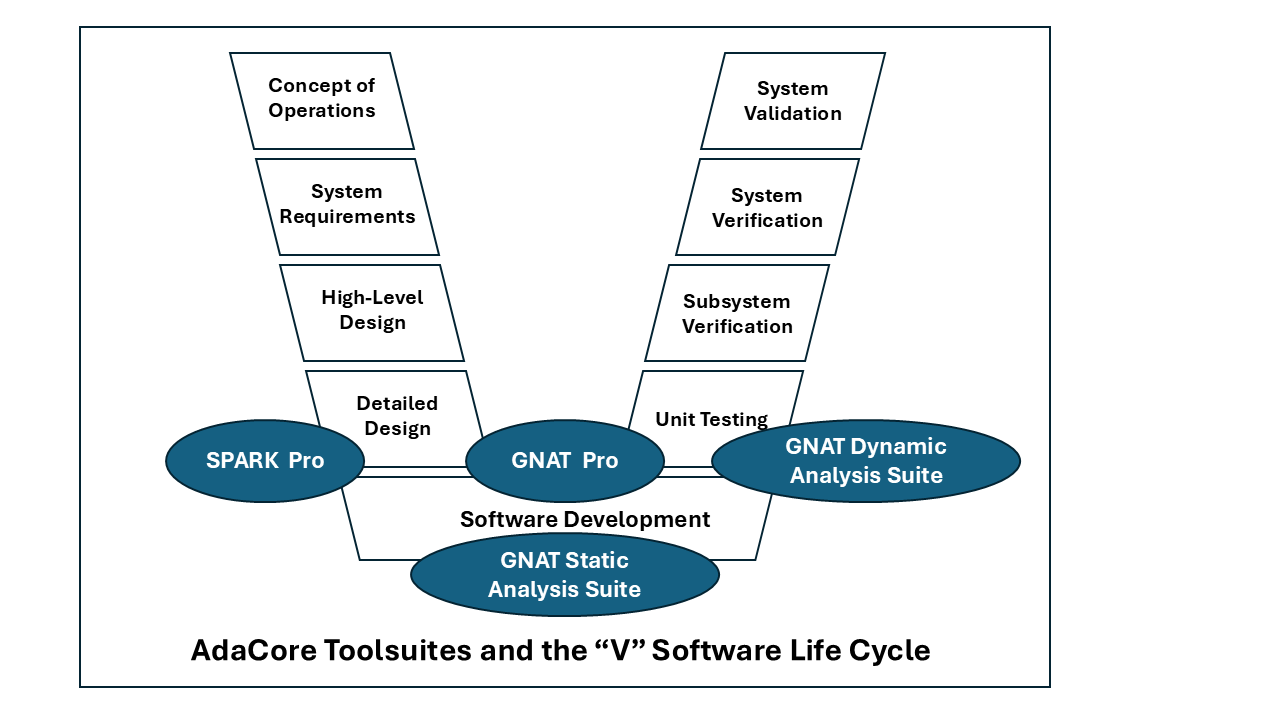
As can be seen in the figure, AdaCore's toolsuites apply towards the bottom of the V. In summary:
The SPARK Pro static analysis toolsuite (see Static Verification: SPARK Pro) applies during Detailed Design and Software Development. It includes a proof tool that verifies properties ranging from correct information flows to functional correctness.
The GNAT Pro development environment (see GNAT Pro Development Environment) applies during Detailed Design, Software Development, and Unit Testing. It consists of gcc-based program build tools, an integrated and tailorable graphical user interface, accompanying tools, and a variety of supplemental libraries (including some for which qualification material is available for ECSS‑E‑ST‑40C and ECSS‑Q‑ST‑80C.)
The GNAT Static Analysis Suite (see Static Verification: GNAT Static Analysis Suite (GNAT SAS)) applies during Software Development. It contains a variety of tools for Ada, including a vulnerability detector that can be used retrospectively to detect issues in existing codebases and/or during new projects to prevent errors from being introduced.
The GNAT Dynamic Analysis Suite (see GNAT Dynamic Analysis Suite (GNAT DAS)) applies during Software Development and Unit Testing. One of these tools, GNATcoverage, supports code coverage and reporting at various levels of granularity for both Ada and C. It can be used during unit and integration testing.
The following sections describe the tools in more detail and show how they can assist in developing and verifying space system software.
3.2. Static Verification: SPARK Pro¶
SPARK Pro is an advanced static analysis toolsuite for the SPARK subset of Ada, bringing mathematics-based confidence to the verification of critical code. Built around the GNATprove formal analysis and proof tool, SPARK Pro combines speed, flexibility, depth and soundness, while minimizing the generation of false alarms. It can be used for new high-assurance code (including enhancements to or hardening of existing codebases at lower assurance levels, written in full Ada or other languages such as C) or projects where the existing high-assurance coding standard is sufficiently close to SPARK to ease transition.
3.2.1. Powerful Static Verification¶
The SPARK language supports a wide range of static verification techniques. At one end of the spectrum is basic data- and control-flow analysis; i.e., exhaustive detection of errors such as attempted reads of uninitialized variables, and ineffective assignments (where a variable is assigned a value that is never read). For more critical applications, dependency contracts can constrain the information flow allowed in an application. Violations of these contracts — potentially representing violations of safety or security policies — can then be detected even before the code is compiled.
In addition, SPARK supports mathematical proof and can thus provide high confidence that the software meets a range of assurance requirements: from the absence of run-time exceptions, to the enforcement of safety or security properties, to compliance with a formal specification of the program's required behavior.
As described earlier (see Levels of Adoption of Formal Methods), the SPARK technology can be introduced incrementally into a project, based on the assurance requirements. Each level, from Bronze to Platinum, comes with associated benefits and costs.
3.2.2. Minimal Run-Time Footprint¶
Developers of systems with security requirements are generally advised to "minimize the trusted computing base", making it as small as possible so that high-assurance verification is feasible. However, adhering to this principle may be difficult if a Commercial Off-the-Shelf (COTS) library or operating system is used: how are these to be evaluated or verified without the close (and probably expensive) cooperation of the COTS vendor?
For the most critical embedded systems, SPARK supports the so-called Bare-Metal development style, where SPARK code is running directly on a target processor with little or no COTS libraries or operating system at all. SPARK is also designed to be compatible with GNAT Pro's Light run-time library. In a Bare-Metal / light run-time development, every byte of object code can be traced to the application’s source code and accounted for. This can be particularly useful for systems that must undergo evaluation by a national technical authority or regulator.
SPARK code can also run with a specialized run-time library on top of a real-time operating system (RTOS), or with a full Ada run-time library and a commercial desktop operating system. The choice is left to the system designer, not imposed by the language.
3.2.3. CWE Compatibility¶
SPARK Pro detects a number of dangerous software errors in The MITRE Corporation's Common Weakness Enumeration (CWE), and the tool has been certified by the MITRE Corporation as a "CWE-Compatible" product [1].
The table below lists the CWE weaknesses detected by SPARK Pro:
CWE Weakness |
Description |
|---|---|
CWE 119, 120, 123, 124, 125, 126, 127, 129, 130, 131 |
Buffer overflow/underflow |
CWE 136, 137 |
Variant record field violation, Use of incorrect type in inheritance hierarchy |
CWE 188 |
Reliance on data layout |
CWE 190, 191 |
Numeric overflow/underflow |
CWE 193 |
Off-by-one error |
CWE 194 |
Unexpected sign extension |
CWE 197 |
Numeric truncation error |
CWE 252, 253 |
Unchecked or incorrectly checked return value |
CWE 366 |
Race Condition |
CWE 369 |
Division by zero |
CWE 456, 457 |
Use of uninitialized variable |
CWE 466, 468, 469 |
Pointer errors |
CWE 476 |
Null pointer dereference |
CWE 562 |
Return of stack variable address |
CWE 563 |
Unused or redundant assignment |
CWE 682 |
Range constraint violation |
CWE 786, 787, 788, 805 |
Buffer access errors |
CWE 820 |
Missing synchronization |
CWE 821 |
Incorrect synchronization |
CWE 822, 823, 824, 825 |
Pointer errors |
CWE 835 |
Infinite loop |
3.2.4. SPARK Pro and the ECSS Standards¶
SPARK Pro can help a space software supplier in various ways. At a general level, the technology supports the development of analyzable and portable code:
The tool enforces a number of Ada restrictions that are appropriate for high-assurance software. For example, the use of tasking constructs outside the Ravenscar subset will be flagged.
The full Ada language has several implementation dependencies that can result in the same source program yielding different results when compiled by different compilers. For example, the evaluation order in expressions is not specified, and different orderings may produce different values if one of the terms has a side effect. (A detailed discussion of this issue and its mitigation may be found in [2].) Such implementation dependencies are either prohibited in SPARK and thus detected by SPARK Pro, or else they do not affect the computed result. In either case the use of SPARK Pro eases the effort in porting the code from one environment to another.
More specifically, using the SPARK Pro technology can help the supplier meet ECSS‑E‑ST‑40C and ECSS‑Q‑ST‑80C requirements in a number of areas. These comprise the ones mentioned earlier (see SPARK and the ECSS Standards) that relate to the SPARK language, together with the following:
ECSS‑E‑ST‑40C
§5.4 Software requirements and architecture engineering process
§5.4.3 Software architecture design
§5.5 Software design and implementation engineering process
§5.5.2 Design of software items
§5.6 Software validation process
§5.6.3 Validation activities with respect to the technical specification
§5.6.4 Validation activities with respect to the requirements baseline
§5.8 Software verification process
§5.8.3 Verification activities
§5.10 Software maintenance process
§5.10.4 Modification implementation
§5.11 Software security process
§5.11.2 Process implementation
§5.11.3 Software security analysis
§5.11.5 Security activities in the software life cycle
Annex U - Software code verification
ECSS-Q-ST-80C
§5.6 Tools and supporting environment
§5.6.1 Methods and tools
§5.6.2 Development environment selection
§6.2 Requirements applicable to all software engineering processes
§6.2.3 Handling of critical software
§6.2.9 Software security
§6.2.10 Handling of security sensitive software
§6.3 Requirements applicable to individual software engineering processes or activities
§6.3.4 Coding
§7.1 Product quality objectives and metrication
§7.1.3 Assurance activities for product quality requirements
§7.2 Product quality requirements
§7.2.3 Test and validation documentation
Details are provided in chapters Compliance with ECSS-E-ST-40C and Compliance with ECSS-Q-ST-80C.
3.3. GNAT Pro Development Environment¶
This section summarizes the main features of the two editions of AdaCore's GNAT Pro language toolsuite, Enterprise and Assurance. These editions correspond to different levels of customer requirements and are available for Ada, C, C++, and Rust.
Based on the GNU GCC technology, GNAT Pro for Ada supports the Ada 83, Ada 95, Ada 2005, and Ada 2012 standards, as well as selected features of Ada 2022. It includes:
several Integrated Development Environments (See Integrated Development Environments (IDEs));
a comprehensive toolsuite including a stack analysis tool (see GNATstack) and a visual debugger;
a library that enables customers to develop their own source analysis tools for project-specific needs (see Libadalang); and
other useful libraries and bindings.
For details on the tools and libraries supplied with GNAT Pro for Ada, see [3] and [4].
Other GNAT Pro products handle multiple versions of C (from C89 through C18), C++ (from C++98 through C++17), and Rust.
3.3.1. GNAT Pro Enterprise¶
GNAT Pro Enterprise is a development environment for producing critical software systems where reliability, efficiency, and maintainability are essential. Several features of GNAT Pro for Ada are noteworthy:
Run-Time Library Options
The product allows a variety of choices for the run-time library, based on the target platform. In addition to the Standard run-time, which is available for platforms that can support the full language capabilities, the product on some bare-metal or RTOS targets also includes restricted libraries that reduce the footprint and/or help simplify safety certification:
The Light Run-Time library offers a minimal application footprint while retaining compatibility with the SPARK subset and verification tools. It supports a non-tasking Ada subset suitable for certification / qualification and/or storage-constrained embedded applications. It supersedes the ZFP (Zero FootPrint) and Cert run-time libraries from previous GNAT Pro releases.
The Light-Tasking Run-Time library augments the Light run-time library with support for the Ravenscar and Jorvik tasking profiles. It supersedes the Ravenscar-Cert and Ravenscar-SFP libraries from previous GNAT Pro releases.
The Embedded Run-Time library provides a subset of the Standard Ada run-time library suitable for target platforms lacking file I/O and networking support. It supersedes the Ravenscar-Full library from previous GNAT Pro releases.
Although limited in terms of dynamic Ada semantics, these predefined libraries
fully support static Ada constructs such as private types, generic templates,
and child units. Some dynamic semantics are also supported. For example,
tagged types (at library level) and other Object-Oriented Programming features
are supported, as is dynamic dispatching.
The general use of dynamic dispatching at the application level can be
prevented through pragma Restrictions.
Details on these libraries may be found in the "Predefined GNAT Pro Run-Times" chapter of [4].
Adapted versions of the earlier ZFP and Ravenscar-Cert libraries have been qualified under ECSS‑E‑ST‑40C and ECSS‑Q‑ST‑80C at criticality category B.
Run-Time Library Configurability
A traditional problem with predefined profiles is their inflexibility: if a feature outside a given profile is needed, then it is the developer's responsibility to address the certification issues deriving from its use. GNAT Pro for Ada accommodates this need by allowing the developer to define a profile for the specific set of features that are used. Typically this will be for features with run-time libraries that require associated certification materials. Thus the program will have a tailored run-time library supporting only those features that have been specified.
More generally, the configurable run-time capability allows specifying support for Ada's dynamic features in an à la carte fashion ranging from none at all to full Ada. The units included in the executable may be either a subset of the standard libraries provided with GNAT Pro, or specially tailored to the application. This latter capability is useful, for example, if one of the predefined profiles implements almost all the dynamic functionality needed in an existing system that has to meet new safety-critical requirements, and where the costs of adapting the application without the additional run-time support are considered prohibitive.
Enhanced Data Validity Checking
Improper or missing data validity checking is a notorious source of security vulnerabilities in software systems. Ada has always offered range checks for scalar subtypes, but GNAT Pro goes further, offering enhanced validity checking that can protect a program against malicious or accidental memory corruption, failed I/O devices, and so on. This feature is particularly useful in combination with automatic Fuzz testing, since it offers strong defense for invalid data at the software boundary of a system.
3.3.2. GNAT Pro Assurance¶
GNAT Pro Assurance extends GNAT Pro Enterprise with specialized support, including bug fixes and known problems analyses, on a specific version of the toolchain. This product edition is especially suitable for applications with long-lived maintenance cycles or assurance requirements, since critical updates to the compiler or other product components may become necessary years after the initial release.
3.3.2.1. Sustained Branches¶
Unique to GNAT Pro Assurance is a service known as a sustained branch: customized support and maintenance for a specific version of the product. A project on a sustained branch can monitor relevant known problems, analyze their impact and, if needed, update to a newer version of the product on the same development branch (i.e., not incorporating changes introduced in later versions of the product).
Sustained branches are a practical solution to the problem of ensuring toolchain stability while allowing flexibility in case an upgrade is needed to correct a critical problem.
3.3.2.2. Source to Object Traceability¶
Source-to-object traceability is required in standards such as DO ‑ 178C/ED ‑ 12C, and a GNAT Pro compiler option can limit the use of language constructs that generate object code that is not directly traceable to the source code. As an add-on service, AdaCore can perform an analysis that demonstrates this traceability and justifies any remaining cases of non-traceable code.
3.3.2.3. Compliance with the ECSS Standards¶
Supplementing the support provided by GNAT Pro for Ada (see GNAT Pro and the ECSS Standards), GNAT Pro Assurance helps compliance with the following requirements from ECSS‑E‑ST‑40C and ECSS‑Q‑ST‑80C:
ECSS‑E‑ST‑40C
§5.9 Software operation process
§5.9.2 Process implementation
§5.9.4 Software operation support
§5.9.5 User support
ECSS‑Q‑ST‑80C
§6.2 Requirements applicable to all software engineering processes
§6.2.6 Verification
§6.3 Requirements applicable to individual software engineering processes or activities
§6.3.9 Maintenance
3.3.3. Libadalang¶
Libadalang is a library included with GNAT Pro that gives applications access to the complete syntactic and semantic structure of an Ada compilation unit. This library is typically used by tools that need to perform some sort of static analysis on an Ada program.
AdaCore can assist customers in developing libadalang-based tools to meet their specific needs, as well as develop such tools upon request.
Typical libadalang applications include:
Static analysis (property verification)
Code instrumentation
Design and document generation tools
Metric testing or timing tools
Dependency tree analysis tools
Type dictionary generators
Coding standard enforcement tools
Language translators (e.g., to CORBA IDL)
Quality assessment tools
Source browsers and formatters
Syntax directed editors
3.3.4. GNATstack¶
GNATstack is a static analysis tool included with GNAT Pro that enables an Ada/C software developer to accurately predict the maximum size of the memory stack required for program execution.
GNATstack statically predicts the maximum stack space required by each task in an application. The computed bounds can be used to ensure that sufficient space is reserved, thus guaranteeing safe execution with respect to stack usage. The tool uses a conservative analysis to deal with complexities such as subprogram recursion, while avoiding unnecessarily pessimistic estimates.
This static stack analysis tool exploits data generated by the compiler to compute worst-case stack requirements. It performs per-subprogram stack usage computation combined with control flow analysis.
GNATstack can analyze object-oriented applications, automatically determining maximum stack usage on code that uses dynamic dispatching in Ada. A dispatching call challenges static analysis because the identity of the subprogram being invoked is not known until run time. GNATstack solves this problem by statically determining the subset of potential targets (primitive operations) for every dispatching call. This significantly reduces the analysis effort and yields precise stack usage bounds on complex Ada code.
GNATstack's analysis is based on information known at compile time. When the tool indicates that the result is accurate, the computed bound can never be exceeded.
On the other hand, there may be cases in which the results will not be accurate (the tool will report such situations) because of some missing information (such as the maximum depth of subprogram recursion, indirect calls, etc.). The user can assist the tool by specifying missing call graph and stack usage information.
GNATstack's main output is the worst-case stack usage for every entry point, together with the paths that result in these stack sizes. The list of entry points can be automatically computed (all the tasks, including the environment task) or can be specified by the user (a list of entry points or all the subprograms matching a given regular expression).
GNATstack can also detect and display a list of potential problems when computing stack requirements:
Indirect (including dispatching) calls. The tool will indicate the number of indirect calls made from any subprogram.
External calls. The tool displays all the subprograms that are reachable from any entry point for which there is no stack or call graph information.
Unbounded frames. The tool displays all the subprograms that are reachable from any entry point with an unbounded stack requirement. The required stack size depends on the arguments passed to the subprogram. For example:
procedure P(N : Integer) is
   S : String (1..N);
begin
   ...
end P;
Cycles. The tool can detect all the cycles (i.e., potential recursion) in the call graph.
GNATstack allows the user to supply a text file with the missing information, such as the potential targets for indirect calls, the stack requirements for external calls, and the maximal size for unbounded frames.
3.3.4.1. Compliance with the ECSS Standards¶
The GNATstack tool can help meet several requirements in ECSS‑E‑ST‑40C and ECSS‑Q‑ST‑80C; details are provided in chapters Compliance with ECSS-E-ST-40C and Compliance with ECSS-Q-ST-80C. In summary, these are the relevant sections of the two standards:
ECSS-E-ST-40C
§5.8 Software verification process
§5.8.3 Verification activities
§5.8.3.5f Verification of code / source code robustness
Annex U - Software code verification
Verification check 12 (memory leaks)
ECSS-Q-ST-80C
§5.6 Tools and supporting environment
§5.6.2 Development environment selection
3.3.5. GNAT Pro for Rust¶
The Rust language was designed for software that needs to meet stringent requirements for both assurance and performance: Rust is a memory-safe systems-programming language with software integrity guarantees (in both concurrent and sequential code) enforced by compile-time checks. The language is seeing growing use in domains such as automotive systems and is a viable choice for other high-assurance software.
AdaCore's GNAT Pro for Rust is a complete development environment for the Rust programming language, supporting both native builds and cross compilation to embedded targets. The product is not a fork of the Rust programming language or the Rust tools. Instead, GNAT Pro for Rust is a professionally supported build of a selected version of rustc and other core Rust development tools that offers stability for professional and high-integrity Rust projects. Critical fixes to GNAT Pro for Rust are upstreamed to the Rust community, and critical fixes made by the community to upstream Rust tools are backported as needed to the GNAT Pro for Rust code base. Additionally, the Assurance edition of GNAT Pro for Rust includes the sustained branch service (see Sustained Branches) that strikes the balance between tool stability and project flexibility.
3.3.6. Integrated Development Environments (IDEs)¶
GNAT Pro includes several graphical IDEs for invoking the build tools and accompanying utilities and monitoring their outputs.
3.3.6.1. GNAT Studio¶
GNAT Studio is a powerful and simple-to-use IDE that streamlines software development from the initial coding stage through testing, debugging, system integration, and maintenance. It is designed to allow programmers to get the most out of GNAT Pro technology.
Functionality
GNAT Studio's extensive navigation and analysis tools can generate a variety of useful information including call graphs, source dependencies, project organization, and complexity metrics, giving a thorough understanding of a program at multiple levels. The IDE allows interfacing with third-party version control systems, easing both development and maintenance.
Robustness, Flexibility and Extensibility
Especially suited for large, complex systems, GNAT Studio can import existing projects from other Ada implementations while adhering to their file naming conventions and retaining the existing directory organization. Through the multi-language capabilities of GNAT Studio, components written in C and C++ can also be handled. The IDE is highly extensible; additional tools can be plugged in through a simple scripting approach. It is also tailorable, allowing various aspects of the program's appearance to be customized in the editor.
Ease of Learning and Use
GNAT Studio is intuitive to new users thanks to its menu-driven interface with extensive online help (including documentation on all the menu selections) and tool tips. The Project Wizard makes it simple to get started, supplying default values for almost all of the project properties. For experienced users, it offers the necessary level of control for advanced purposes; e.g., the ability to run command scripts. Anything that can be done on the command line is achievable through the menu interface.
Support for Remote Programming
Integrated into GNAT Studio, Remote Programming provides a secure and efficient way for programmers to access any number of remote servers on a wide variety of platforms while taking advantage of the power and familiarity of their local PC workstations.
3.3.6.2. VS Code Extensions for Ada and SPARK¶
AdaCore's extensions to Visual Studio Code (VS Code) enable Ada and SPARK development with a lightweight editor, as an alternative to the full GNAT Studio IDE. Functionality includes:
Syntax highlighting for Ada and SPARK files
Code navigation
Error diagnostics (errors reported in the Problems pane)
Build integration (execution of GNAT-based toolchains from within VS Code)
Display of SPARK proof results (green/red annotations from GNATprove)
Basic IntelliSense (completion and hover information for known symbols)
3.3.6.3. Eclipse Support – GNATbench¶
GNATbench is an Ada development plug-in for Eclipse and Wind River's Workbench environment. The Workbench integration supports Ada development on a variety of VxWorks real-time operating systems. The Eclipse version is primarily for native applications, with some support for cross development. In both cases the Ada tools are tightly integrated.
3.3.6.4. GNATdashboard¶
GNATdashboard serves as a one-stop control panel for monitoring and improving the quality of Ada software. It integrates and aggregates the results of AdaCore's various static and dynamic analysis tools (GNATmetric, GNATcheck, GNATcoverage, SPARK Pro, among others) within a common interface, helping quality assurance managers and project leaders understand or reduce their software's technical debt, and eliminating the need for manual input.
GNATdashboard fits naturally into a continuous integration environment, providing users with metrics on code complexity, code coverage, conformance to coding standards, and more.
3.3.7. GNAT Pro and the ECSS Standards¶
GNAT Pro can help meet a number of requirements in ECSS‑E‑ST‑40C and ECSS‑Q‑ST‑80C; details are provided in chapters Compliance with ECSS-E-ST-40C and Compliance with ECSS-Q-ST-80C. In summary, these are the relevant sections of the two standards:
ECSS‑E‑ST‑40C
§5.4 Software requirements and architecture engineering process
§5.4.3 Software architecture design
§5.5 Software design and implementation engineering process
§5.5.2 Design of software items
§5.5.3 Coding and testing
§5.5.4 Integration
§5.7 Software delivery and acceptance process
§5.7.3 Software acceptance
§5.8 Software verification process
§5.8.3 Verification activities
§5.9 Software operation process
§5.9.2 Process implementation
§5.10 Software maintenance process
§5.10.2 Process implementation
§5.10.4 Modification implementation
§5.11 Software security process
§5.11.2 Process implementation
§5.11.3 Software security analysis
§5.11.5 Security analysis in the software lifecycle
Annex U - Source code verification
Verification check 12 (memory leaks)
ECSS‑Q‑ST‑80C
§5.2 Software product assurance programme management
§5.2.7 Quality requirements and quality models
§5.6 Tools and supporting environments
§5.6.1 Methods and tools
§5.6.2 Development environment selection
§6.2 Requirements applicable to all software engineering processes
§6.2.3 Handling of critical software
§6.2.6 Verification
§6.2.9 Software security
§6.3 Requirements applicable to individual processes or activities
§6.3.4 Coding
§6.3.9 Maintenance
§7.1 Product quality objectives and metrication
§7.1.3 Assurance objectives for product quality requirements
§7.1.5 Basic metrics
AdaCore's ZFP (Zero Footprint) minimal run-time library (superseded by the Light run-time in current GNAT Pro releases) on LEON2 ELF has been qualified at criticality category B, and the Ravenscar SFP (Small Footprint) QUAL run-time library (superseded by the Light-Tasking run-time) on LEON2 and LEON3 boards have been qualified at criticality category B (see [5]).
3.4. Static Verification: GNAT Static Analysis Suite (GNAT SAS)¶
GNAT SAS is a set of Ada static analysis tools that complement GNAT Pro for Ada. These tools can save time and effort in general during software development and verification, and they are useful in particular in supporting compliance with ECSS standards.
3.4.1. Defects and Vulnerability Analyzer¶
One of the main tools in GNAT SAS is an Ada source code analyzer that detects run-time and logic errors that can cause safety or security vulnerabilities in a codebase. This tool inspects the code for potential bugs before program execution, serving as an automated peer reviewer. It can be used on existing codebases, thereby helping vulnerability analysis during a security assessment or system modernization, and when performing impact analysis during updates. It can also be used on new projects, helping to find errors early in the development life-cycle when they are least costly to repair. Using control-flow, data-flow, and other advanced static analysis techniques, this analysis tool detects errors that would otherwise only be found through labor-intensive debugging.
The defects and vulnerability analyzer can be used from within the GNAT Pro development environment, or as part of a continuous integration regime. As a stand-alone tool, it can also be used with projects that do not use GNAT Pro for compilation.
3.4.1.1. CWE Compatibility¶
The tool can detect a number of "Dangerous Software Errors" in the MITRE Corporation's Common Weakness Enumeration, and the tool has been certified (under its previous name, CodePeer) by The MITRE Corporation as a "CWE-Compatible" product [1].
Here are the weaknesses that are detected:
CWE weakness |
Description |
|---|---|
CWE 120, 124, 125, 126, 127, 129, 130, 131 |
Buffer overflow/underflow |
CWE 136, 137 |
Variant record field violation, Use of incorrect type in inheritance hierarchy |
CWE 190, 191 |
Numeric overflow/underflow |
CWE 362, 366 |
Race condition |
CWE 369 |
Division by zero |
CWE 457 |
Use of uninitialized variable |
CWE 476 |
Null pointer dereference |
CWE 561 |
Dead (unreachable) code |
CWE 563 |
Unused or redundant assignment |
CWE 570 |
Expression is always false |
CWE 571 |
Expression is always true |
CWE 628 |
Incorrect arguments in call |
CWE 667 |
Improper locking |
CWE 682 |
Incorrect calculation |
CWE 820 |
Missing synchronization |
CWE 821 |
Incorrect synchronization |
CWE 835 |
Infinite loop |
3.4.1.2. Compliance with the ECSS Standards¶
The defects and vulnerability analyzer can help meet a number of requirements in ECSS‑E‑ST‑40C and ECSS‑Q‑ST‑80C; details are provided in chapters Compliance with ECSS-E-ST-40C and Compliance with ECSS-Q-ST-80C. In summary, these are the relevant sections of the two standards:
ECSS-E-ST-40C
§5.5 Software design and implementation engineering process
§5.5.2 Design of software items
§5.6 Software validation process
§5.6.3 Validation activities with respect to the technical specification
§5.6.4 Validation activities with respect to the requirements baseline
§5.8 Software verification process
§5.8.3 Verification activities
§5.10 Software maintenance process
§5.10.4 Modification implementation
§5.11 Software security process
§5.11.2 Process implementation
§5.11.3 Software security analysis
§5.11.5 Software analysis in the software life cycle
Annex U - Software code verification
ECSS-Q-ST-80C
§5.6. Tools and supporting environment
§5.6.1 Methods and tools
§5.6.2 Development environment selection
§6.2 Requirements applicable to all software engineering processes
§6.2.3 Handling of critical software
§6.2.6 Verification
§6.2.9 Software security
§7.1 Product quality objectives and metrication
§7.1.3 Assurance activities for product quality requirements
3.4.2. GNATmetric¶
GNATmetric is a static analysis tool that calculates a set of commonly used industry metrics, thus allowing developers to estimate code complexity and better understand the structure of the source program. This information also facilitates satisfying the requirements of certain software development frameworks and is useful in conjunction with GNATcheck (for example, in reporting and limiting the maximum subprogram nesting depth).
3.4.2.1. Compliance with the ECSS Standards¶
The GNATmetric tool can help meet a number of requirements in ECSS‑E‑ST‑40C and ECSS‑Q‑ST‑80C; details are provided in chapters Compliance with ECSS-E-ST-40C and Compliance with ECSS-Q-ST-80C. Here is a summary:
ECSS-E-ST-40C
§5.10 Software maintenance process
§5.10.4 Modification implementation
ECSS-Q-ST-80C
§5.2 Software product assurance programme management
§5.2.7 Quality requirements and quality models
§6.3 Requirements applicable to individual software engineering processes or activities
§6.3.4 Coding
§7.1 Product quality objectives and metrication
§7.1.3 Assurance activities for product quality requirements
§7.1.5 Basic metrics
3.4.3. GNATcheck¶
GNATcheck is a coding standard verification tool that is extensible and rule-based. It allows developers to completely define a project-specific coding standard as a set of rules, for example a subset of permitted language features and/or code formatting and style conventions. It verifies a program's conformance with the resulting rules and thereby facilitates demonstration of a system's compliance with a certification standard's requirements on language subsetting.
GNATcheck provides:
An integrated "Ada Restrictions" mechanism for banning specific features from an application. This can be used to restrict features such as tasking, exceptions, dynamic allocation, fixed- or floating point, input/output, and unchecked conversions.
Restrictions specific to GNAT Pro, such as banning features that result in the generation of implicit loops or conditionals in the object code, or in the generation of elaboration code.
Additional Ada semantic rules resulting from customer input, such as ordering of parameters, normalized naming of entities, and subprograms with multiple returns.
An easy-to-use interface for creating and using a complete coding standard.
Generation of project-wide reports, including evidence of the level of compliance with a given coding standard.
Over 30 compile-time warnings from GNAT Pro that detect typical error situations, such as local variables being used before being initialized, incorrect assumptions about array lower bounds, certain cases of infinite recursion, incorrect data alignment, and accidental hiding of names.
Style checks that allow developers to control indentation, casing, comment style, and nesting level.
AdaCore's GNATformat tool [6], which formats Ada source code according to the GNAT coding style [7], can help avoid having code that violates GNATcheck rules. GNATformat is included in the GNAT Pro for Ada toolchain.
GNATcheck comes with a query language (LKQL, for Language Kit Query Language) that lets developers define their own checks for any in-house rules that need to be followed. GNATcheck can thus be customized to meet an organization's specific requirements, processes and procedures.
3.4.3.1. Compliance with the ECSS Standards¶
The GNATcheck tool can help meet a number of requirements in ECSS‑E‑ST‑40C and ECSS‑Q‑ST‑80C; details are provided in chapters Compliance with ECSS-E-ST-40C and Compliance with ECSS-Q-ST-80C. In summary, these are the relevant sections of the two standards:
ECSS-E-ST-40C
§5.8 Software verification process
§5.8.3 Verification activities
§5.8.3.4 Verification of the software detailed design
§5.10 Software maintenance process
§5.10.4 Modification implementation
§5.11 Software security process
§5.11.2 Process implementation
§5.11.3 Software security analysis
§5.11.5 Software analysis in the software life cycle
Annex U - Software code verification
Verification check 3 (infinite loops)
Verification check 4 (misuse of arithmetic and logical operators)
ECSS-Q-ST-80C
§5.6 Tools and supporting environment
§5.6.2 Development environment selection
§6.2 Requirements applicable to all software engineering processes
§6.2.3 Handling of critical software
§6.3 Requirements applicable to individual software engineering processes or activities
§6.3.4 Coding
§7.1 Product quality objectives and metrication
§7.1.3 Assurance activities for product quality requirements
3.5. GNAT Dynamic Analysis Suite (GNAT DAS)¶
3.5.1. GNATtest¶
The GNATtest tool helps create and maintain a complete unit testing infrastructure for complex projects. It captures the simple idea that each public subprogram (these are known as visible subprograms in Ada) should have at least one corresponding unit test. GNATtest takes a project file as input, and produces two outputs:
The complete harnessing code for executing all the unit tests under consideration. This code is generated completely automatically.
A set of separate test stubs for each subprogram to be tested. These test stubs are to be completed by the user.
GNATtest handles Ada's Object-Oriented Programming features and can be used to help verify tagged type substitutability (the Liskov Substitution Principle) that can be used to demonstrate consistency of class hierarchies.
Testing a private subprogram is outside the scope of GNATtest but can be implemented by defining the relevant testing code in a private child of the package that declares the private subprogram. Additionally, hybrid verification can help (see Hybrid Verification): augmenting testing with the use of SPARK to formally prove relevant properties of the private subprogram.
3.5.2. GNATemulator¶
GNATemulator is an efficient and flexible tool that provides integrated, lightweight target emulation.
Based on the QEMU technology, a generic and open-source machine emulator and virtualizer, GNATemulator allows software developers to compile code directly for their target architecture and run it on their host platform, through an approach that translates from the target object code to native instructions on the host. This avoids the inconvenience and cost of managing an actual board, while offering an efficient testing environment compatible with the final hardware.
There are two basic types of emulators. The first can serve as a surrogate for the final hardware during development for a wide range of verification activities, particularly those that require time accuracy. However, they tend to be extremely costly, and are often very slow. The second, which includes GNATemulator, does not attempt to be a complete time-accurate target board simulator, and thus it cannot be used for all aspects of testing. But it does provide a very efficient and cost-effective way to execute the target code very early in the development and verification processes. GNATemulator thus offers a practical compromise between a native environment that lacks target emulation capability, and a cross configuration where the final target hardware might not be available soon enough or in sufficient quantity.
3.5.3. GNATcoverage¶
GNATcoverage is a code coverage analysis tool. Its results are computed from trace files that show which program constructs have been exercised by a given test campaign. With source code instrumentation, the tool produces these files by executing an alternative version of the program, built from source code instrumented to populate coverage-related data structures. Through an option to GNATcoverage, the user can specify the granularity of the analysis: statement coverage, decision coverage, or Modified Condition / Decision Coverage (MC/DC).
Source-based instrumentation brings several major benefits: efficiency of tool execution (much faster than alternative coverage strategies using binary traces and target emulation, especially on native platforms), compact-size source trace files independent of execution duration, and support for coverage of shared libraries.
3.5.4. GNATfuzz¶
GNATfuzz is a fuzzing tool; i.e., a tool that automatically and repeatedly executes tests and generates new test cases at a very high frequency to detect faulty behavior of the system under test. Such anomalous behavior is captured by monitoring the system for triggered exceptions, failing built-in assertions, and signals such as SIGSEGV.
Fuzz testing has proven to be an effective mechanism for finding corner-case vulnerabilities that traditional human-driven verification mechanisms, such as unit and integration testing, can miss. Since such vulnerabilities can often lead to malicious exploitations, fuzzing technology can help meet security verification requirements.
However, fuzz-testing campaigns are complex and time-consuming to construct, execute and monitor. GNATfuzz simplifies the process by analyzing a code base and identifying subprograms that can act as fuzz-test entry points. GNATfuzz then automates the creation of test harnesses suitable for fuzzing. In addition, GNATfuzz will automate the building, executing and analyzing of fuzz-testing campaigns.
GNATfuzz can serve a useful role as part of the software development and verification life cycle processes. For example, by detecting anomalous behavior such as data corruption due to task or interrupt conflicts, GNATfuzz can help prevent defects from being introduced into the source code.
3.5.5. TGen¶
TGen is an experimental run-time library / marshalling technology that can be used by GNATtest and/or GNATfuzz to automate the production of test cases for Ada code. It performs type-specific low-level processing to generate test vectors for subprogram parameters, such as uniform value distribution for scalar types and analogous strategies for unconstrained arrays and record discriminants. A command-line argument specifies the number of test values to be generated, and these can then be used as input to test cases created by GNATtest.
TGen can also be used with GNATfuzz, to help start a fuzz-testing campaign when the user supplies an initial set of test cases where some may contain invalid data. GNATfuzz will utilize coverage-driven fuzzer mutations coupled with TGen to convert invalid test cases into valid ones. TGen represents test data values compactly, removing a large amount of memory padding that would otherwise be present for alignment of data components. With its space-efficient representation, TGen significantly increases the probability of a successful mutation that results in a new valid test case.
3.5.6. GNAT Dynamic Analysis Suite and the ECSS Standards¶
The GNAT Dynamic Analysis Suite can help meet a number of requirements in ECSS‑E‑ST‑40C and ECSS‑Q‑ST‑80C; details are provided in chapters Compliance with ECSS-E-ST-40C and Compliance with ECSS-Q-ST-80C. In summary, these are the relevant sections of the two standards:
ECSS-E-ST-40C
§5.5 Software design and implementation engineering process
§5.5.3 Coding and testing
§5.5.4 Integration
§5.6 Software validation process
§5.6.3 Validation activities with respect to the technical specification
§5.6.4 Validation activities with respect to the requirements baseline
§5.8 Software verification process
§5.8.3 Verification activities
§5.10 Software maintenance process
§5.10.4 Modification implementation
§5.11 Software security process
§5.11.2 Process implementation
§5.11.3 Software security analysis
§5.11.5 Security analysis in the software lifecycle
ECSS-Q-ST-80C
§5.6 Tools and supporting environment
§5.6.1 Methods and tools
§5.6.2 Development environment selection
§6.2 Requirements applicable to all software engineering processes
§6.2.3 Handling of critical software
§6.2.9 Software security
§6.3 Requirements applicable to individual software engineering processes or activities
§6.3.5 Testing and validation
§7.1 Product quality objectives and metrication
§7.1.3 Assurance activities for product quality requirements
§7.1.5 Basic metrics
§7.2 Product quality requirements
§7.2.3 Test and validation documents
3.6. Support and Expertise¶
Every AdaCore product subscription comes with front-line support provided directly by the product developers themselves, who have deep expertise in the Ada language, domain-specific software certification / qualification standards, compilation technologies, embedded system technology, and static and dynamic verification. AdaCore's development engineers have extensive experience supporting customers in critical areas including space, commercial and military avionics, air traffic management/control, railway, and automotive. Customers' questions (requests for guidance on feature usage, suggestions for technology enhancements, or defect reports) are handled efficiently and effectively.
Beyond this bundled support, AdaCore also provides Ada language and tool training, on-site consulting on topics such as how to best deploy the technology, and mentoring assistance on start-up issues. On-demand tool development or ports to new platforms are also available.
Bibliography